
Enhancing Power Electronics Reliability with Micred Power Tester
Power electronics components such as MOSFETs, diodes, transistors, and IGBTs play vital roles in energy generation, conversion, and control. With rising energy demands in consumer and industrial applications, manufacturers face the challenge of increasing power levels and current load capabilities while maintaining high quality and reliability. Applications like railway traction and hybrid vehicles demand incredibly reliable power modules that endure long lifetimes and numerous cycles.
Innovation in Power Module Technologies
To address these demands, innovations in ceramic substrates, ribbon bonding, and solderless die-attach technologies have emerged:
- Ceramic Substrates: These have improved heat transfer coefficients, reducing operating temperatures and enhancing thermal management.
- Ribbon Bonding: This technology replaces thick bond wires, enabling better current handling and improved mechanical stability.
- Solderless Die-Attach: Sintered silver with ultra-low thermal resistance enhances the cycling capabilities and overall reliability of power modules.

Accelerated Testing with Micred Power Tester
The Micred Power Tester significantly enhances the testing process by providing automated power cycling combined with real-time, in-progress failure diagnostics. This innovative approach allows for continuous monitoring and analysis during testing, offering immediate insights into the performance and reliability of power electronics components. By automating the power cycling process, it reduces the time and labor traditionally required for manual testing.
NOTE:
Despite these advancements, thermal and thermomechanical stresses can still result in system failures such as bond wire degradation, solder fatigue, and die or substrate cracks. Traditional postmortem power cycle failure testing is repetitive, time-consuming, and must be conducted in lab settings.
Despite these advancements, thermal and thermomechanical stresses can still result in system failures such as bond wire degradation, solder fatigue, and die or substrate cracks. Traditional postmortem power cycle failure testing is repetitive, time-consuming, and must be conducted in lab settings.
NOTE:
Despite these advancements, thermal and thermomechanical stresses can still result in system failures such as bond wire degradation, solder fatigue, and die or substrate cracks. Traditional postmortem power cycle failure testing is repetitive, time-consuming, and must be conducted in lab settings.
Key Advantages:
- Automated Power Cycling: Enables rapid and efficient testing suitable for both manufacturing and laboratory environments
- Structural Analysis: Provides vital data on current, voltage, and die temperature, facilitating the detection of changes or failures within the package.
- Enhanced Development: Accelerates package development, reliability testing, and batch checking of incoming parts.
- Data Utilization: The outputs from the Micred Power Tester can calibrate and validate detailed models in thermal simulation software.
Practical Testing on IGBT Modules
We conducted comprehensive tests on four medium-power IGBT modules using the Micred Power Tester to thoroughly demonstrate its powerful capabilities and effectiveness. This extensive testing was aimed to showcase not only the automated power cycling feature but also the system’s real-time, in-progress diagnostics.
Results Highlights
Voltage Evolution:
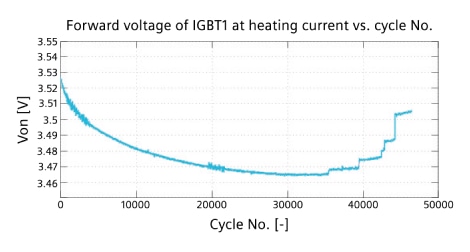
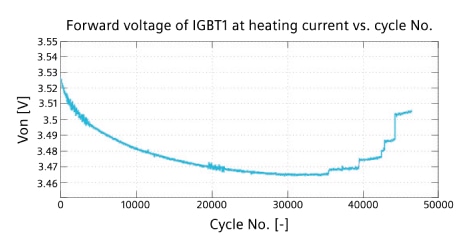
- IGBT1: Showed a decreasing voltage trend in the first 3,000 cycles due to a 5°C drop in average device temperature.
- IGBT3: Experienced an earlier increase in voltage, leading to a proportional decrease in heating current, which in turn extended the lifespan of the module.

The clear identification of failure modes, such as die-attach degradation and bond wire damage, provides rapid diagnosis and significantly reduces the need for postmortem analysis.

The clear identification of failure modes, such as die-attach degradation and bond wire damage, provides rapid diagnosis and significantly reduces the need for postmortem analysis.
The clear identification of failure modes, such as die-attach degradation and bond wire damage, provides rapid diagnosis and significantly reduces the need for postmortem analysis.
Conclusion
Reliability in high-power electronics is paramount. The Micred Power Tester offers a groundbreaking solution for accelerated testing across tens of thousands to millions of cycles, ensuring real-time diagnostics and eliminating the need for traditional, labor-intensive failure analysis.
Experience the future of power electronics testing with the Micred Power Tester, ensuring the longevity and reliability of your power modules efficiently and effectively. Engage with our cutting-edge solution to transform your reliability testing processes today. technology, continuously improving and innovating to meet the ever-evolving demands of high-power applications.